How Overhead Crane Systems Fit Into Modern Industrial Steel Buildings
Overhead crane installation represents one of the most important infrastructure decisions for industrial facilities, manufacturing plants, and warehouses. These material-handling systems can improve productivity, reduce manual handling, and help facilities move large or heavy materials efficiently. Their successful implementation, however, depends on proper structural and operational planning from the beginning.
For businesses investing in new industrial steel buildings or upgrading existing facilities, understanding the relationship between the crane system and building design is essential. Crane capacity, span, service classification, travel speed, hook height, runway configuration, and operating environment can all influence the structure.
The integration of overhead cranes into steel building construction requires careful coordination among the owner, structural engineer, building manufacturer, crane supplier, foundation engineer, electrical team, and contractor. This type of early, organized collaboration is a central part of effective steel building project management. Unlike a simple accessory, a building-supported crane transfers vertical, lateral, longitudinal, and dynamic forces into the runway, columns, bracing, and foundations.
Planning these requirements early helps provide the load-bearing capacity, clearances, runway alignment, maintenance access, and electrical service needed for safe, reliable operation throughout the facility’s useful life.
The Critical Role of Pre-Engineered Steel Buildings
Pre-engineered metal buildings can offer important advantages for overhead crane integration. The clear-span capabilities of steel construction can reduce interior obstructions, providing usable floor space and more direct material flow.
A pre-engineered metal building is not automatically designed to support a crane. The crane requirements must be included in the project criteria so the building manufacturer and responsible engineers can account for the correct loads, deflection limits, connections, bracing, and foundation reactions.
Steel building systems can be engineered for a wide range of lifting operations, from light-duty workstations and jib cranes to higher-capacity bridge cranes. The appropriate building solution depends on more than rated lifting capacity. Span, service frequency, operating speed, number of cranes, simultaneous lifts, and the materials being handled also affect design.
Steel construction can also accommodate future expansion when that possibility is identified during planning. A facility may be designed for an additional runway, a future building bay, or a higher crane reaction than initially required. That future capacity must be documented and engineered; owners should never assume an existing runway or structure can accept a larger crane without evaluation.
Building-Supported and Independently Supported Cranes
Some crane runways are supported directly by the building columns, while others use an independent freestanding structure within the building. A building-supported system can conserve floor space, but it transfers crane forces into the primary building structure. A freestanding runway can separate some crane demands from the building frame, although it introduces additional columns, foundations, and potential floor-space conflicts.
The right approach depends on crane capacity, building geometry, soil conditions, operational layout, cost, and future plans. This decision should be made collaboratively rather than after the building system has already been ordered.
Key Components of Overhead Crane Systems
Understanding the fundamental components of overhead crane installations helps facility managers make informed decisions during the planning phase. Bridge cranes, a common industrial configuration, include a horizontal bridge that spans the operating area and travels along elevated runways. The trolley and hoist move across the bridge, allowing loads to travel vertically, laterally, and longitudinally through the facility.
A typical system may include:
- The bridge girder or girders
- End trucks and wheels
- A trolley and hoist
- Runway rails and beams
- Column brackets or independent supports
- Stops, bumpers, controls, and warning devices
- Electrical conductors and disconnects
The bridge spans the width of the intended operating area within the building, while the runways guide travel along its length. Each component must be compatible with the selected crane, runway, building structure, and operating conditions.
Runway beams must resist the crane’s weight, lifted loads, and forces generated during travel, braking, acceleration, and load movement. Support columns and brackets transfer these forces into the primary structure and foundations.
Runway alignment is critical, but no single tolerance applies to every installation. Required tolerances depend on the crane manufacturer, runway design, rail system, span, service class, and governing project documents. Surveying and installation should follow the approved specifications for the selected system.
Structural Load Considerations
The loads imposed by overhead cranes extend beyond the weight of the equipment and lifted material. Engineers evaluate several types of forces and the combinations in which they may occur.
Vertical loads include the crane’s dead weight, trolley and hoist weight, lifted load, and runway components. Wheel loads are concentrated at specific locations and move along the runway as the crane operates.
Dynamic effects account for how lifting, lowering, acceleration, braking, and load movement affect the structure. The appropriate impact allowance is determined using the applicable code, crane criteria, manufacturer information, and engineering standards; it should not be assumed to be one universal percentage.
Lateral forces can develop perpendicular to the runway because of trolley motion, skewing, acceleration, or load movement. Longitudinal forces act along the runway during bridge travel and braking. These forces must be transferred through runway connections, columns, bracing, and foundations.
Structural analysis also considers:
- Multiple cranes operating on one runway
- Cranes operating in adjacent bays
- Deflection and vibration limits
- Fatigue from repeated loading cycles
- Wind effects on applicable outdoor equipment
- Seismic and other building-code load combinations
Modern structural analysis allows engineers to model these conditions and provide adequate safety factors and serviceability performance throughout the supporting structure. Crane runway girders also experience repeated load cycles, making fatigue and connection detailing important for frequently used systems.
The Crane Service Classification Matters
Two cranes with the same rated capacity can impose different long-term demands. A crane used occasionally for equipment maintenance does not experience the same number of cycles as one moving production materials throughout multiple shifts.
The crane supplier should help determine the service classification based on load magnitude, operating frequency, travel distance, environment, and expected use. Providing an accurate duty profile helps engineers and manufacturers select suitable motors, brakes, wheels, controls, structural components, and maintenance intervals.
Building Design Requirements for Crane Integration
Successful overhead crane installation begins with the building configuration. Clear height requirements must account for the crane bridge, trolley, hoist, hook approach, required clearances, and the height of materials or equipment being lifted.
Building eave height and hook height are not the same. The usable lifting height is influenced by the distance from the floor to the runway, the crane’s headroom, and the hook’s upper and lower limits. Planning around eave height alone can leave a completed facility unable to lift materials as high as operations require.
Column spacing directly affects runway design and overall system cost. Wider spacing means fewer support points but may require heavier runway members. Closer spacing can reduce runway spans but may introduce more columns, brackets, foundations, and potential operational conflicts. The most practical arrangement balances building efficiency with the crane and production layout.
The design must also coordinate roof bracing, wall girts, piping, ducts, lighting, fire protection, cable trays, and other building services with the crane’s operating envelope. Required clearances must be maintained between moving crane components and fixed obstructions. This coordination becomes especially important in mixed-use industrial developments built with steel, where manufacturing, storage, distribution, and material-handling activities may share the same facility.
Foundation and Slab Coordination
Foundation design must be coordinated with crane reactions from the project’s early stages. Crane-support columns may require different footings, piers, reinforcing, or anchor systems than columns supporting the building alone.
Soil conditions affect bearing capacity, settlement, and foundation selection. Differential settlement can change runway elevation or alignment, potentially contributing to wheel wear, tracking problems, and additional forces. A project-specific geotechnical investigation gives the foundation engineer information needed to evaluate these risks.
The floor slab may also require coordination with crane operations. Heavy loads, mobile equipment, rigging activities, component storage, and future machinery can influence slab thickness, reinforcement, joints, flatness, and load capacity even when the overhead crane is supported independently of the slab.
Electrical and Control Systems
Modern overhead crane systems rely on electrical and control infrastructure that must be integrated into the building design. Power requirements depend on crane capacity, motor sizes, travel speeds, duty cycle, voltage, controls, and simultaneous operation. The electrical engineer should evaluate starting current, demand, protective devices, disconnecting means, voltage drop, and available fault current.
A large crane may require dedicated distribution equipment, but a dedicated transformer is not automatically necessary for every installation. The solution should be based on calculated electrical requirements and the facility’s overall distribution system.
Conductor systems provide power to moving cranes through technologies such as festoon systems, conductor bars, or cable reels. Each approach has spatial and protective requirements that affect building design. Festoon systems need adequate space for cable loops and carriers, while conductor bars must be positioned or guarded to limit accidental contact.
Controls can include pendant stations, radio remotes, cab controls, variable-frequency drives, anti-collision systems, positioning features, and semi-automated functions. Variable-frequency drives can provide smoother acceleration and deceleration when properly selected and programmed.
Grounding, bonding, surge protection, emergency disconnects, control-system security, and electromagnetic compatibility should be coordinated with applicable codes, manufacturer requirements, and the facility’s operating environment.
Safety Considerations and Compliance
Overhead crane installation and operation must comply with applicable regulations, adopted codes, manufacturer instructions, and project requirements. The Occupational Safety and Health Administration (OSHA) establishes requirements for overhead and gantry cranes in general industry, including rated-load markings, clearances, inspections, testing, maintenance, and load handling. Requirements can differ when cranes are used in construction or specialized environments.
The American Society of Mechanical Engineers (ASME) publishes B30 safety standards addressing cranes, hoists, rigging, and related equipment. Crane Manufacturers Association of America specifications and other industry references may also apply according to the selected equipment and contract documents.
OSHA requires new and altered covered cranes to be inspected before initial use and operationally tested. When a rated-load test is required, the test load must not exceed 125% of rated load unless otherwise recommended by the manufacturer. Testing should follow applicable requirements and approved procedures rather than using an arbitrary overload.
Worker safety also depends on facility layout and operating practices. Planning considerations may include:
- Adequate lighting and operator visibility
- Clearances from fixed obstructions
- Warnings and restricted operating areas
- Accessible emergency controls and disconnects
- Safe access for inspection and maintenance
- Documented procedures and designated operators
- Rigging practices appropriate to the lifted load
Operators should avoid carrying suspended loads over people, and loads must not exceed the crane’s marked rated capacity except under permitted testing conditions.
Installation Process and Timeline Considerations
The installation of an overhead crane system follows a coordinated sequence that depends on the building, crane configuration, erection plan, equipment access, and contractor responsibilities.
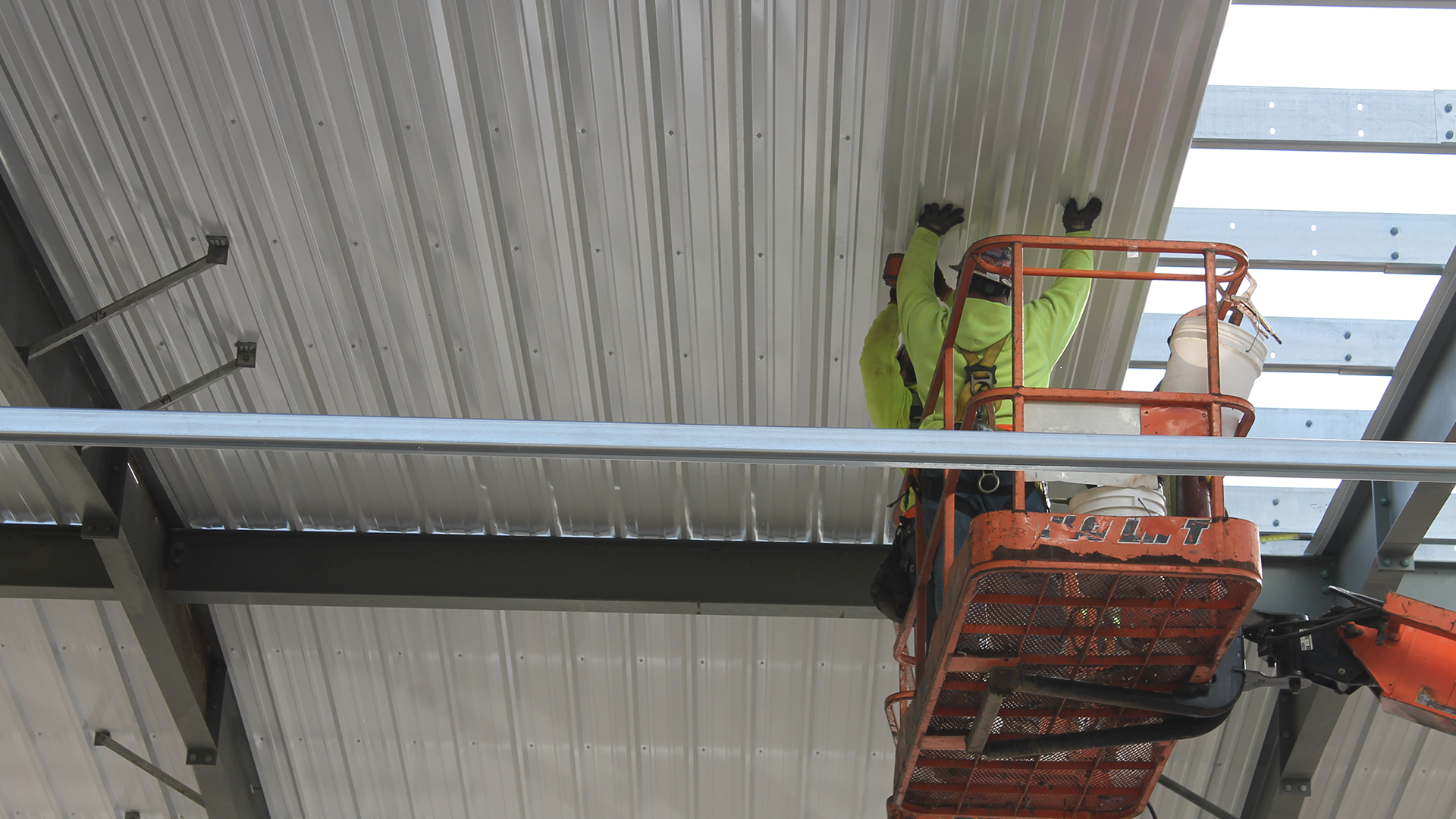
Runway beams may be installed as part of structural erection or after portions of the primary building frame are complete. The project team must coordinate temporary stability, lifting access, roofing and wall installation, electrical work, equipment deliveries, and safe separation among trades.
Runway alignment and elevation directly affect crane tracking, wheel loads, component wear, and performance. Qualified installers should use appropriate survey methods to verify the runway against the crane manufacturer’s and project’s approved tolerances. A generic tolerance should not be substituted for the requirements of the selected system.
Crane assembly and testing follow the approved installation sequence. Bridge and trolley components are lifted into place, electrical systems are connected, and required inspections and operational testing verify functions such as hoisting, lowering, bridge travel, trolley travel, limit switches, and safety devices.
Documents That Keep the Team Aligned
Clear documentation helps prevent gaps between the building and crane scopes. Project teams should coordinate crane data sheets, rated capacity, service class, span, wheel reactions, hook approaches, runway elevations, electrical requirements, control type, clearances, and future provisions.
Responsibilities should also be clear for runway rails, brackets, electrification, stops, bumpers, access systems, installation, surveying, testing, permits, and inspections. An item shown on one supplier’s drawing is not necessarily included in that supplier’s contract.
Maintenance Access and Long-Term Serviceability
Building design should include provisions for inspection and maintenance throughout the crane’s operating life. Where walkways, platforms, ladders, or stairs are provided or required, they must comply with applicable safety requirements and maintain proper clearance from moving equipment.
The need for permanent access depends on crane configuration, service requirements, facility operations, and governing standards. Even where routine service uses lifts or other access equipment, the building layout must provide enough space and a suitable floor or route for that equipment.
Bridge cranes require inspection and maintenance of components such as wheels, bearings, brakes, wire rope or chain, hooks, controls, electrical conductors, limit switches, and structural connections. OSHA requires a preventive-maintenance program based on the crane manufacturer’s recommendations for covered equipment.
Building design should also consider how major components will be removed and replaced. Large doors, removable panels, laydown areas, lifting points, or equipment routes may be necessary for motors, gearboxes, hoists, wheels, and bridge components.
Adequate lighting, electrical outlets, lockout provisions, and safe service areas can make maintenance more efficient. Facilities with heat, cold, dust, moisture, corrosive chemicals, explosive atmospheres, or outdoor exposure may require equipment and maintenance strategies selected specifically for those conditions.
Cost Factors and Budget Planning
Overhead crane installation costs vary widely, and generic price ranges can become outdated quickly. Crane capacity is only one factor. Span, lift height, service class, travel speed, control features, runway length, electrification, access, freight, installation conditions, testing, and regional labor rates can all affect pricing.
Building structural costs associated with crane integration are also project-specific. Columns, runway girders, brackets, bracing, foundations, clear height, and building width may all change after crane reactions and operating requirements are established.
A complete budget should consider:
- Crane and hoist equipment
- Runway beams, rails, supports, and stops
- Building and foundation reinforcement
- Electrical distribution and crane electrification
- Freight, unloading, assembly, and erection equipment
- Surveying, inspections, and testing
- Access platforms and safety systems
- Training, maintenance, and spare parts
- Contingency and future-expansion provisions
Comparing only the initial crane price can obscure important lifecycle differences. Energy use, inspection frequency, component availability, expected duty, downtime, service support, and upgrade potential all influence long-term value.
Future Expansion and Flexibility
Manufacturing facilities should consider future needs when planning overhead crane installations. Building structures can sometimes be designed to accommodate a future crane, added runway, or increased reaction. Any reserved capacity should be clearly documented in the drawings and operating records. Owners considering future growth should also coordinate crane coverage with plans for modular steel building additions for industrial facilities.
Planning for a higher future capacity does not mean that a larger crane can later be installed without review. A qualified engineer and the equipment manufacturer should evaluate the crane, runway, connections, columns, bracing, foundations, electrical system, and clearances before any modification or rerating.
Multiple crane systems may be necessary for large facilities or complex operations. Building design should consider how cranes interact, including parallel runways, shared runways, overlapping work zones, collision risks, coordinated lifts, and required separation.
Modular building design can allow facilities to expand production areas while extending crane coverage. Planning for future building additions should include provisions for extending runway systems into new bays, maintaining compatible floor elevations, and coordinating column spacing between existing and future structures.
Questions to Answer Before Selecting a Crane System
Before finalizing the building and crane design, the project team should define:
- What is the maximum lifted load, including below-the-hook devices?
- How frequently will the crane operate?
- What span, runway length, and hook coverage are required?
- What is the tallest load and required hook height?
- Will more than one crane operate in the same area?
- What electrical service and control method are needed?
- What environmental conditions will affect the equipment?
- How will inspection, maintenance, and component replacement occur?
- Could capacity, coverage, or production needs change later?
Accurate answers help the project team avoid paying for unnecessary capacity while reducing the risk of a facility that cannot support its intended operations.
Frequently Asked Questions About Overhead Cranes in Steel Buildings
Can any steel building support an overhead crane?
No. The building, runway, connections, bracing, and foundations must be designed or verified for the selected crane reactions and operating conditions. An existing steel building should be evaluated by qualified professionals before a crane is installed.
When should the crane supplier become involved?
Ideally, the crane supplier should be involved during early building planning. Preliminary crane dimensions, wheel reactions, service classification, power requirements, and clearances can affect the building layout and structural design.
What determines the required building height?
The required height depends on the tallest handled load, desired hook height, crane headroom, bridge and runway elevation, roof structure, equipment clearances, and building systems above or around the crane.
Can an existing crane be upgraded to lift more weight?
A crane should not be rerated based on assumption. OSHA requires modifications and supporting structures to be thoroughly checked for the new rated load by a qualified engineer or equipment manufacturer, followed by applicable testing and updated load markings.
How often must an overhead crane be inspected?
Inspection frequency depends on the component, service conditions, manufacturer requirements, and applicable regulations. OSHA divides regular-service inspections into frequent and periodic classifications, with intervals influenced by use, wear, and exposure. Operators and owners should maintain a documented inspection and preventive-maintenance program.
Building for Operational Excellence: The Long-Term Value of Proper Crane Integration
Overhead crane installation represents a significant investment that can shape an industrial facility’s capabilities for decades. The most successful installations result from early collaboration among facility planners, structural engineers, the building manufacturer, crane specialists, electrical professionals, and contractors.
The relationship between building design and crane performance cannot be overstated. Facilities that treat cranes as afterthoughts may face limited hook coverage, inadequate clear height, structural modifications, access conflicts, or expensive retrofits. Buildings planned around verified crane requirements can deliver more efficient material flow, maintainable systems, and better options for future growth.
For businesses planning new industrial facilities or major renovations, investing in proper crane integration can support operational efficiency, worker safety, and expansion flexibility. The structural decisions made during initial planning establish capabilities that may influence facility performance throughout its useful life.
Partner with Steel Construction Specialists Who Understand Material Handling
Red Direct brings comprehensive expertise in designing and constructing industrial steel buildings optimized for overhead crane installations. Our team understands the critical relationship between structural engineering and material handling systems, ensuring your facility delivers maximum operational capability from day one.